• Membership
    • Reasons to Join the Nonprofit Center >
      • Reason to Renew Now
    • Nonprofit Membership
    • Champion Membership
    • Individual Membership
    • Consultant Membership
    • Corporate Membership >
      • Corporate - Business Volunteer Council Membership
      • Corporate Members
    • Current Member List
    • Membership FAQ
    • Manage My Membership
    • Member Logins
  • Services
    • About Our Services
    • Training
    • Volunteer Milwaukee >
      • Summer Youth Volunteer Opportunities
      • Service Enterprise Initiative
      • Global Youth Service Day
      • Holiday Giving Tree
    • Nonprofit Jobs
    • Consulting
    • Agency Executives Group - For Executive Directors
    • Financial Management
  • Training
    • About Our Training
    • Upcoming Trainings >
      • Administration
      • Communications
      • Fund Development >
        • Fund Development Certificate
        • Fund Development Instructors
      • Leadership
      • Volunteerism
      • Everything Else
    • Training Calendar
    • Roundtables/Circles
  • Consulting
    • About Our Organization Development Consulting Services
    • Accounting & Contracted Services
    • Consultants Directory
  • Events
    • 2017 Inspire By Example Awards - Volunteer Celebration
    • Giving Tree
    • 2016 Nonprofit Leadership Summit
    • 2016 Inspire By Example Awards - Volunteer Celebration
    • Calendar of Events
  • Resources
    • Summer Youth Volunteer Opportunities
    • Blog
    • Nonprofit Salary & Benefits Survey
    • Share Your Story
    • NPC-NTEN Partnership
    • NPC-Verified Volunteers Partnership
    • Starting a Nonprofit
  • About
    • Annual Report 2015
    • Mission & History
    • Staff and Board of Directors
    • Contact Us
  • Donate
  • NPC Welcomes New CEO Robert Meiskins
  • Consultant Membership
  • Global Youth Service Day
  • 2017 Global Youth Service Day
  • Product
  • AmeriCorps Position
  • Holiday Giving Tree
  • 2017 Giving Tree
  • New Page
  • Sneak Peek at GrantStation Insider

Fund Development Myths Debunked for Milwaukee Nonprofits 

6/16/2016

11 Comments

 
Blog from the Big Chair

By Rob Meiksins, CEO
 
I can’t tell you how many times I’ve heard it from Milwaukee nonprofit executives, and every time I hear it I cringe.  “We’re in financial trouble,” they say.  “I’m going to have to fix things:  I’ll hire a grant writer.”  Argh! as Charlie Brown used to say.  Grant writers are wonderful people and do important work.  But generating income is about far more than putting words on a piece of paper or website.
 
Here’s another one: “My board isn’t doing enough.”  This is shorthand for: “We’re in financial trouble and I need my board to raise funds now.”  That executive has probably never involved the board in fundraising but expects that, magically, the directors will ride in on their white horses and save the day.
One more cringe moment.  “I need to find an angel donor. You know, that millionaire next door that no one ever knew had a lot of money.” So you're telling me that millionaire next door has never had any contact with your organization—but maybe, just maybe, he’s interested in your cause? Cringe.
 
It’s not that fund development for Milwaukee nonprofits is impossible—it’s just that there are many misconceptions about how to do it that run rampant in our sector. To bust those myths and teach nonprofits viable fund development strategies, UW Parkside has developed a Fund Development Certificate program that will be offered here at the Nonprofit Center of Milwaukee. 
 
3 Fund Development Myths Debunked
 
Going back to our cringe moments above, here are three fund development myths, along with the facts that contradict them. This is the kind of information that Milwaukee nonprofit executives and fund development staff will learn in the new fund development certificate program:
 
Myth #1: Hiring a grant writer will solve your funding crisis.
 
A report from the Center for Charitable Statistics points out that almost half of funding for nonprofits comes from fees for services and goods. Private contributions only account for 13.3% of income for nonprofits. To really fix a funding crisis, the nonprofit executive needs to pay attention to earned revenue. Of course many people say there’s nothing unearned about charitable giving:  all donations are earned through very hard work. However, according to Giving USA, 62% of all gifts to nonprofits in 2015 were from individuals. People. Not foundations or corporations. Putting those statistics together, a grant writer pursuing foundation and corporate giving is going after less than 6% of nonprofit funding. 
 
Myth #2: Your board can magically raise funds instantaneously.
 
There is a cycle of fund raising that involves identifying donors, cultivating them, asking for a gift, thanking them for the gift, involving them in the organization, and on and on.  You have to diligently establish a culture of philanthropy at your organization, and that takes time and energy.  So start now, before it's a crisis.
 
Myth #3: There’s a millionaire next door waiting to give you lots of money.
 
By definition, a prospect—according to Andy Robinson—is a person who has the capacity to give, has the habit of giving, and knows about you.  So that millionaire next door may have the capacity to give, but does she like to make donations?  If not, you’re out of luck. If she likes to give, it is really unlikely that she’ll give to you if she knows nothing about what you do, so you are out of luck again. The old adage is that it takes seven contacts to get the gift. Simply put, it takes work.  Work to find the donor, work to learn about them, and work to get them to want to give. 
 
Who Is the Fund Development Certificate Program For?
 
The point of the fund development curriculum we’re offering this fall is to help nonprofit staff develop the good habits required for effective fund development.  This is not a class for the desperate, but for people who want to take fund development seriously and establish a sustainable culture of philanthropy at their organization. 
 
There was a strong team that came together at UW Parkside to design this curriculum.  We wanted it to be engaging, interactive, intense, and comprehensive.  We wanted to be able to say that our graduates know how to do fund development the right way.  We hoped that they would learn about the work that’s involved, but also about the rewards.  Knowing that you’ve helped connect a donor to a cause they’re excited about and want to have an impact on is a great feeling. Knowing you’ve helped a cause connect to a donor who can provide some of the resources needed to deliver on the mission is equally amazing. 
 
If this is what you want to do or are being asked to do for your organization, I encourage you enroll in the fund development certificate program.

Want to learn more? Register for a free presentation and Q & A session on the Fund Development Certificate Program, July 13 at 12 noon at NPC, 2819 W. Highland Ave., Milwaukee, WI. ​​

11 Comments

Blog from the Big Chair: The Big Shiny New Idea

1/27/2016

1 Comment


​By Robert Meiksins, CEO

Recently I had the honor of serving on a panel with Janel Hines, of the Greater Milwaukee Foundation, and Scott Gelzer, formerly of the Faye McBeath Foundation. We had been invited to talk to the Association of Fundraising Professionals of Southeastern Wisconsin about trends we see in philanthropy and how nonprofits might respond. This blog draws from some of my comments on that panel.

The nature of the relationship between nonprofits and organized philanthropies, such as foundations and corporations, is evolving. The latest trend in that evolution is the rise of “activist donors” taking the lead as the initiators of local grants to nonprofits, with nonprofits in the role of the responder. The activist donor decides what they think is a critical issue and what should be done about it. Organizations have to come up with a way of responding to that in order to access local grants to nonprofits. Some call it strategic philanthropy; others think it is worse than that.

Often, the process starts out innocently enough with a donor, let’s call it The Foundation, thinking about all the grants it has made over the years. “You know what?” says The Foundation to the nonprofit community in general.  . “We see an issue that is facing our community. A really, really important issue. We need to do something about it. Say,” says The Foundation. “Don’t they have an issue very similar to this in Philadelphia? What are they doing there? Or San Diego, or Baltimore, or Portland!” Leaders of local nonprofits who are already doing something to address that issue suddenly have a sinking feeling, knowing what is coming next. “I know!” says The Foundation. “We need to do some research and exploration.”

The next few months see a decrease in funding from The Foundation as they invest in research which may be led by consultants who have no knowledge of the field and so believe they are inventing the wheel for the first time. There might even be a few meetings in which local nonprofits are asked to bring their ideas on the subject. Without pay, of course.

The Moment We've All Been Waiting For

Then it happens. The Big Shiny New Idea is unveiled. “This,” says The Foundation, “is what we are all going to do to address the issue.” Initiatives that fit the Big Shiny New Idea are given funding. Initiatives that cannot fit their square peg into the round hold of the Big Shiny New Idea are not funded. Other foundations and corporations see the Big Shiny New Idea, get excited, and start sending their funds over in support of its almost certainty of success.

This really is all well intentioned. The Foundation in question is doing this for all the right reasons, wanting to have an impact on a significant issue. The impact can be big and it can be positive. But there can be unintended fallouts from this kind of process. Let me count the ways why I am hesitant about the Big Shiny New Idea.

For one, those organizations that had already been involved in the work are sometimes forgotten. It's dangerous when "people who are most affected by issues are not funded and trusted to lead the efforts to address them," writes Vu Le in a recent post on his blog, Nonprofit With Balls. There is only a certain amount of money available in this community to support work on any issue. If a large slice of the pie is suddenly sent to the Big Shiny New Idea, it means that the organizations that have been in the trenches all this time will see a reduction of their slice. In some cases, it might be a good thing, because they simply were not getting the job done. In other cases, it is a bad thing, because the funding was decreased just because the existing organization did not fit easily into the Big Shiny New Idea, even though they are doing good work.

Trickle-Down Philanthropy

The concept behind the Big Shiny New Idea is similar to the trickle-down theory of economics. The large agencies receive the money because the donors can have confidence that there is infrastructure in place to manage the volume of work that needs to get done. The intent is for the big agency to partner with and share the work and the money with small, community-based agencies. But, as with the trickle-down theory of economics, the practice is not always the same as the theory. Rich people don’t get rich by giving their money away: they get rich by keeping it. The big agencies did not get big by subcontracting and partnering. They got big by getting the grant, keeping the money, and doing the work themselves. And that’s what happens often in this scenario. Not to mention that the large agency is often a white agency and they “partner” with agencies of color but don’t share the work or the money.

Finally, the Big Shiny New Idea is never intended to last forever. It is intended to get something started that would lead to significant change in the way we address the issue. In other words, the money will stop at some point, often when the next Big Shiny New Idea comes along. What then? Too often, neither the donor nor the nonprofits have taken the time to think this through and develop ways to make the initiative sustainable when that original seed funding comes to an end. Both the donors and the nonprofits are guilty in this case. Often it is the nonprofits that are most culpable when they choose not to hear or heed the donor’s warning that the funding has three years, two years, one year left to go.

Honoring What's Working Well Locally
​

It used to be the case that a nonprofit would see an issue, come up with a solution, go to the donor, and ask for financial support. The nonprofit was leading the process. Then came “donor-centered fundraising,” which sees the process as a partnership. Nonprofits and donors each have priorities, and the question is whether or not they match. If they do, the funds are made available. The activist donor is a new element of the process. It’s not a bad idea, as such, to have activist donors and their Big Shiny New Ideas. I just hope we can remember, respect, and continue to support what we already have that is working well. 

I would like nonprofits to be comfortable in speaking up, identifying what is working and what is not. What are your stories of agencies, people, and ideas that have benefitted from the Big Shiny New Idea, and those that may have been left behind? Please use the comments link below to tell your story.

Strengthen Your Nonprofit - Join NPC!
1 Comment

Things I thought I knew about the Nonprofit Center (but didn’t)

5/20/2015

0 Comments

 
Picture
John Jansen is a writer, nonprofit consultant, and former executive director of Community Shares of Greater Milwaukee.
He recently launched a new blog, Strategic Nonprofits - "a place where nonprofit professionals can get answers and contribute ideas." Topics include nonprofit communications, fund development, executive leadership, and more.
By John F. Jansen, NPC Guest Blogger

After many years as a member, I thought I knew everything there was to know about the Nonprofit Center of Milwaukee. 

Boy, was I wrong!

I always knew that NPC:
-   Provides valuable nonprofit workshops  
-   Offers office space to other nonprofits, and
-   Celebrates through its annual events the contributions nonprofits make to our community and its diversity

But only recently did I discover two long-standing and very valuable programs – one that helps nonprofits and one geared to for-profit businesses.  And in true NPC fashion, they are simple and direct services provided by a “one stop shop” unlike any other nonprofit resource in the region.

Nonprofit Consulting Services:

NPC does a lot more to help nonprofits than provide workshops. Nearly every day, Executive Director Leigh Kunde fields phone calls from nonprofit leaders who need help in areas such as financial management, strategic planning, HR, social media and much more.  Leigh can put them in touch instantly with experts in any of these areas. 

Sometimes, the best consultant is right on staff at the Nonprofit Center, where Dan Ullrich can provide guidance on communications issues, Bonnie Andrews on volunteer management, or Gail Kahovic on financial issues.

When an outside consultant is needed, Leigh will set up a meeting between the nonprofit looking for help and a consultant who can provide it, often sitting in to help the nonprofit find a consultant who is a perfect fit for the project.

Nowhere else in the community can a nonprofit get this kind of expert guidance with a single phone call.  Better yet, NPC members receive consulting services at a generous discount.

Business Volunteer Council:

This program bridges the gap between nonprofits and for-profits so that both can benefit. NPC’s corporate and events manager,  Debbie Knepke, can help any business, large or small, create corporate teams and connect with meaningful service opportunities.

Business Volunteer Council members become part of Milwaukee’s leading network for business volunteering and gain access to valuable information and activities, plus one-on-one guidance on supercharging their company’s community service platform.

Community service and social consciousness make for stronger employees, stronger businesses and stronger communities. When companies are engaged in the community, everyone wins.

Helping businesses become better community partners is something all of us can do. Please forward this message on to your business friends so they can take advantage of this valuable program.

The Nonprofit Center's consulting services and Business Volunteer Council are real gems – programs that are unique to Greater Milwaukee and, indeed, to the state of Wisconsin.
0 Comments

Donor Stewardship: Why and How to Cultivate Your Donors

7/3/2014

0 Comments

 
Finding a creative and engaging way to rally supporters can be
just the momentum your community needs to take action.
Related Posts
What You Need to Know to Host a Social Media Fundraising Campaign!

itsAaron: How a Nonprofit Helped a Video Go Viral and Maximized the Impact


Social Media for Nonprofits: 10 Fundraising Tips

Recent Posts
Nonprofit Governance Tips for a Visionary Board

Ask the Governance Doctor: Role of the Executive Committee

WUWM's Town Hall on Black Male Incarceration

Leadership Is Theme for NPC's 2014 Members-Only Events
Get E-news
By Guest Blogger Megan Keane, NTEN

Explains the whys and hows of donor cultivation and shares successful examples to improve your nonprofit fundraising.

When we think about fundraising success, we often think of a handful of viral campaigns that led to impressive fundraising numbers. While these are examples we can learn from, true fundraising success isn’t just the amount of dollars raised - it’s about meaningful and continuous donor stewardship.

You can’t necessarily put a dollar amount on the relationships you cultivate, but it’s these very connections that translate into lasting support for your organization. There’s no exact recipe for donor cultivation, but several key ingredients make for a thriving community of supporters and growing donor base.

Offer involvement
Your supporters don’t just want to write a check; they want to be actively involved in creating change with you. Offer specific ways for people to take part in your cause. That’s just what the city of Baltimore did when they embarked on their B More, Give More campaign as part of #GivingTuesday, an international day of nonprofit giving.

In partnership with GivingCorps, the city brought together local organizations and involved community in the giving process. They provided lots of opportunities to spread the word through social media and other communication channels. Through encouraging residents to “Together make Baltimore the most generous city in America,” individuals were also motivated by being a part of a larger collective movement. Drawing on civic pride and the passion of people for local causes they cared about, Baltimore raised over $5.7 million dollars in just a single day.

Recognize partners
Finding ways to recognize partner organizations and nonprofit colleagues can be an invaluable way to grow your community base. The San Francisco chapter of One Brick, a volunteer-run nonprofit providing local volunteer opportunities, runs monthly happy hour fundraising events. Instead of event proceeds going only to their organization, each month they select an organization they work with as the beneficiary of the event. Not only do these mutually beneficial joint events engender good feeling with partners, but it also results in a cross-pollination of both organizations’ communities. One Brick gains awareness for their organization and brings in new volunteers who are already beginning their involvement with a positive experience.

Express thanks
Never underestimate the power of a “thank you”! At NTEN we do this through our annual Member Appreciation Month. Each year we designate the month of November (already a month associated with gratitude) to express our thanks to all of our members. Throughout the month we provide special free events for nonprofits, procure prizes for daily giveaways, and offer special NTEN swag and other goodies for our local 501 Tech Clubs.

During Member Appreciation Month, we also offer the NTEN Community Impact Year in Review webinar, where we invite several actively involved NTEN members to share their experience with different NTEN programs, and offer an open arena for other community members to share and ask questions. Key supporters receive recognition, and webinar attendees have the opportunity to learn more about the value the community has to offer – and possibly take that next step towards engagement.

Make it fun
But don’t forget to include the fun. Let’s face it, social change is hard work. Finding a creative and engaging way to rally supporters can be just the momentum your community needs to take action. 826DC, a literacy organization, put on a clever fundraising campaign, a ping-pong benefit tournament: Paddlestar Gallatica. Participants had a month to fundraise and competed in the bracket-style tournament at the end of the month.

Along with the clever name, 826DC offered fun pre-tournament events, such as weekly practice sessions where weekly top fundraisers were awarded prizes. And the more money participants raised, the more “cheats” they could obtain at the tournament. By making the campaign social, interactive, and humorous, with a healthy dose of friendly competition, 826DC turned the challenging task of fundraising into an enjoyable way to connect around a cause.

For more great ideas and tips on donor stewardship, check out these helpful resources:

Fired-Up Fundraising
http://www.gailperry.com/resource-center/blog/

CraigConnects Crowdfunding Infographic
http://craigconnects.org/crowdfundinginfographic

Peer Giving Ideas
http://ideas.peergiving.com/

The Fundraising Coach (Marc Pitman)
www.fundraisingcoach.com

First published in NTEN: Change (http://nten.org/NTENChange), June 2014, CC BY-SA 3.0 (http://creativecommons.org/licenses/by-sa/3.0/)

About the Author: Megan Keane is the Membership Director at NTEN, and is a long-time San Francisco bay area resident with an extensive nonprofit background in community management, social media, and volunteer management. She’s a problem solver and network builder passionate about connecting with people both on and offline. Follow her on Twitter @penguinasana.

0 Comments

Social Media for Nonprofits: 10 Fundraising Tips

4/1/2014

0 Comments


Picture
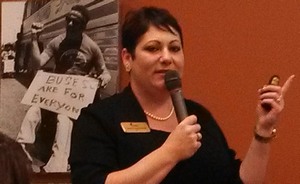
Lynnae Katz-Petted at the Leveraging Social Media to Raise Funds workshop
by Margaret Thom
Membership Manager, Nonprofit Center of Milwaukee

What can social media do for your nonprofit? According to Lynnea Katz-Petted, VP Communications, Association of Fundraising Professionals (AFP) Southeastern Wisconsin, and CEO, Rebuilding Together Greater Milwaukee, and Carol Voss, PR & Marketing Director, IndependenceFirst, it can:
  • Build your brand
  • Position your organization as an expert or primary resource
  • Develop relationships with your supporters to increase fundraising

These two experts shared their experience at “Leveraging Social Media to Raise Funds,” a workshop we offered with the AFP Southeastern Wisconsin. Here are the 10 best tips that I took away.

1) Listen: People are talking about your organization online. Shouldn’t you know what they’re saying? Listening tools include Google alerts, search engines, RSS, twitter search, and social mention. Listening can alert you to feedback, complaints, unmet needs, new services or campaign ideas.

2) Pick your channels strategically: There are many social media channels. Don’t get overwhelmed! Pick the one that best caters to your audience and do it well. Start posting once a week. Build to once a day.
 
3) When posting, use the rule of thirds: Carol’s success formula:
1/3 share other people’s stuff (retweet, share), 1/3 interact with followers,
1/3 post your own stuff. Have a conversation and interact. Avoid the bullhorn effect (sending out your own messages at top volume)!

4) Give the job to someone with organizational expertise: Don’t assign your social media to an inexperienced intern. Social media is an important voice for your whole organization. The person who manages it should have a deep understanding of your work and good judgment.

5) Be consistent with your brand: Be sure your organization looks the same across platforms so people recognize you. You want to clearly convey your identity and stability.

6) Share your content across platforms: Adjust language and content to each platform. Don’t make each post identical.

7) Tell a compelling story: People remember and act upon stories that engage our emotions more than statistics and logic. What stories differentiate you from others? Lynnea recommends asking “What do people value most from their experience with us?” She also recommends the book What’s Your Story? by Craig Wortmann.

8) Show as well as tell: Include visuals. Good images are key to attracting attention. Never underestimate the power of video. Check out YouTube, Vimeo, etc. [You may find this article on related topic interesting.]

9) It’s about relationships: Thank people. Tag or mention people. Promote your sponsors and partners. Have a personality, use humor, follow etiquette, and add value. Online relationships can lead to offline relationship building.

10) Details matter: Proofread grammar and spelling. Use hashtags. (From Twitter: The # symbol, called a hashtag, is used to mark keywords or topics in a Tweet. It was created organically by Twitter users as a way to categorize messages.)

Starting or expanding your social media efforts can be intimidating, but if you take it step by step using the above recommendations, you’ll see results. The Nonprofit Center of Milwaukee offers social media consulting to members and nonmembers, so reach out to us if you need some help!
0 Comments

    Categories

    All
    Capacity & Skill Building
    Fundraising
    Marketing
    Membership
    MKE Nonprofit Spotlight
    Nonprofit Center News
    Nonprofit Governance
    Nonprofit Leadership
    Social Media
    Volunteerism

    Archives

    August 2017
    July 2017
    June 2017
    May 2017
    April 2017
    March 2017
    February 2017
    January 2017
    December 2016
    November 2016
    October 2016
    September 2016
    August 2016
    July 2016
    June 2016
    May 2016
    April 2016
    March 2016
    February 2016
    January 2016
    November 2015
    October 2015
    September 2015
    August 2015
    July 2015
    June 2015
    May 2015
    April 2015
    March 2015
    February 2015
    January 2015
    December 2014
    November 2014
    October 2014
    September 2014
    July 2014
    June 2014
    May 2014
    April 2014

    RSS Feed

Privacy Policy       Terms of Use
©2015 Nonprofit Center of Milwaukee
All Rights Reserved

Nonprofit Center of Milwaukee
2819 W. Highland Blvd., Milwaukee WI 53208  [email protected]  ~  414-344-3933

Picture
Picture
✕